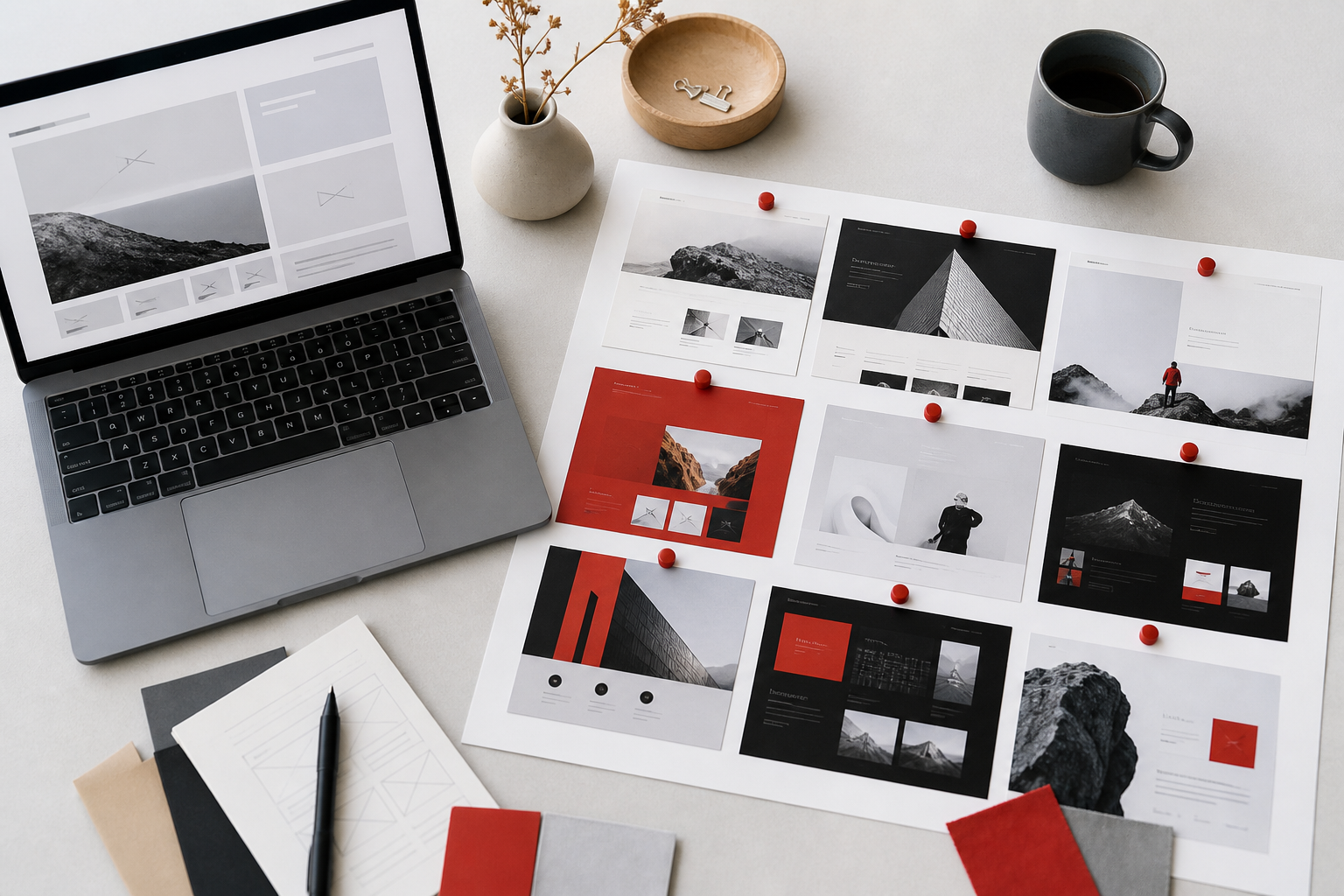
A note on how this is organized, because most portfolio roundups get it wrong: they present one long list, as though a photographer, a copywriter, and a backend developer all need the same site.
They don’t. A visual portfolio can lead with the work. A writing portfolio can’t — nobody scans an essay. A developer portfolio is judged partly on whether the site itself is well built. Same word, three genuinely different problems.
So this is split by discipline, with real examples from Awwwards’ portfolio category, which recognizes portfolio sites specifically.[1]
What separates a good portfolio from an impressive one
Before the examples, the underlying standard — and it’s simpler than most people building portfolios assume.
A portfolio has one job: convince someone to contact you. Everything else is decoration in service of that.
The clearest articulation of what a portfolio actually needs comes from a review of Moritz Oesterlau’s site, which succeeds because visitors want to know about him, see his work, and contact him if they like it — and the portfolio gives all three front and center.[2] That’s the whole test. Most portfolios fail it by hiding at least one of the three.
The second thing that separates good from impressive: case studies with reasoning. The same review notes that Oesterlau’s case studies are comprehensive, covering the full process from identifying challenges through to conclusions, yet remain easy to follow thanks to the formatting.[2]
Screenshots prove you can make things look good. Reasoning proves you understood a problem — and that’s what someone deciding whether to hire you is actually trying to assess. Same standard we apply when reading creative agency portfolios.
Design and creative portfolios
The category with the most competition, and the highest risk of over-designing.
Podium — Awwwards Site of the Day (June 2026) with Portfolio Honors.[1]
Pacôme Pertant Portfolio — Site of the Day (June 2026), Portfolio Honors.[1]
MERSI — Site of the Day (April 2026), Portfolio Honors and a Developer Award.[1]
Artiom Yakushev — Portfolio Honors (December 2025), Site of the Day.[1]
Worth studying alongside these, from the wider curated collections: Olha Lazarieva’s site, described as presenting refined aesthetics, minimal layouts, and a clear focus on craftsmanship, with personal explorations and client work under one cohesive visual direction.[3]
That last detail — personal work and client work coexisting without the site fragmenting — is a genuinely hard problem most designers solve badly, either by hiding personal work entirely or by mixing it in until nobody can tell what was commissioned.
The trap in this category: the most common failure isn’t a boring portfolio, it’s one where the site’s own visual ambition competes with the work it’s showing. If a visitor remembers your scroll animation and not your projects, the site has worked against you.
Developer portfolios
Different standard, because the site is itself a sample. Nobody assesses a designer’s HTML, but a developer’s portfolio is legitimately read as evidence of how they build.
The genre’s outer edge is defined by sites like Bruno Simon’s — a browser-based 3D environment you navigate by driving a small vehicle through it, recognized as Awwwards Site of the Month in January 2026.[4] Technically remarkable, and worth being clear about: it works because Simon teaches Three.js. The site is a demonstration of the exact thing he’s known for.
That’s the actual lesson, and it’s frequently mis-taken. A developer portfolio should demonstrate the work you want to be hired for. If you build accessible, fast, maintainable interfaces, a WebGL showpiece is off-message — a site that loads instantly, works perfectly on a slow phone, and scores well on accessibility says more about your value than a 3D scene would. (Validate that claim with a real speed test.)
Awwwards’ Developer Award category is the place to browse this properly.[5]
What developer portfolios need that design portfolios don’t:
- Code visible or linked — GitHub, live projects
- What you actually built on team projects, stated specifically
- The stack, without turning into a badge collection
- Evidence you can finish things, not just start them
Writing and copywriting portfolios
The hardest category, and the one with the least good advice available.
The core problem: nobody scans writing. A visual portfolio can show twelve pieces in a grid and let the visitor judge in seconds. A writing portfolio asks for reading time — and most visitors won’t give it before deciding.
What works:
Lead with results, not samples. “Landing page copy that lifted signups 40%” gets read; “Sample: SaaS landing page” doesn’t.
Give context before the piece. Who the client was, what the goal was, what the constraint was. The writing means nothing without the brief it answered.
Excerpt rather than embed. Pull the strongest paragraph or headline and link to the full piece. Let visitors choose to go deeper rather than confronting them with a wall of text.
Categorize by type. Long-form, landing pages, email, technical, ghostwriting. Someone hiring for one rarely wants to wade through the others.
Your portfolio site’s own copy is the primary sample. This is the one people miss. If a copywriter’s about page is generic, no case study rescues it — the site itself is the audition. Same principle as website copywriting for client work: the words on the site are the proof.
Art and photography portfolios
Closest to a pure gallery, and the discipline where restraint pays most.
What works: big images, fast loading, minimal chrome, no visual competition from the interface. The site should get out of the way.
What consistently fails: heavy custom cursors and elaborate transitions between images. Someone reviewing a photographer’s work wants to look at photographs, and every interaction between them and the next image is friction.
The practical detail people neglect: image optimization. A photography portfolio is by definition image-heavy. Unoptimized full-resolution files mean visitors leave before the first image renders — the one failure mode that guarantees the work is never seen at all.
The mistakes that cross all disciplines
Too many projects. Six strong pieces beat twenty mixed ones. A portfolio is judged partly on your editorial judgment, and including weak work says you can’t tell the difference.
No contact route. Genuinely common. If the fastest way to reach you is hunting for an email address in a footer, you’ve lost people who were ready.
No context on the work. A screenshot with a client name and nothing else asks the visitor to guess what you contributed.
Not saying what you want. Are you taking freelance work? Open to full-time? Available now? People won’t ask if it isn’t stated.
Stale. Nothing since 2023 reads as “no longer doing this.”
Unclear attribution on team projects. Say what you did specifically. Vagueness reads as overclaiming, even when it isn’t.
Where to keep looking
Any list dates. These don’t:
- Awwwards’ portfolio category — award-winning portfolio sites, updated continuously[1]
- Awwwards Developer Award listings — for technically-led work specifically[5]
- Muzli’s curated portfolio collections — broader net, less experimental[3]
- Site Builder Report’s portfolio roundups — usefully evaluative rather than purely visual[2]
A caution: award galleries skew toward the visually spectacular, which correlates loosely with getting hired. A portfolio that wins awards and a portfolio that converts enquiries are overlapping but distinct targets. Use galleries for craft ideas; validate structure against portfolios of people doing the kind of work you actually want.
The short version
- Every portfolio needs three things immediately available: who you are, the work, and how to make contact
- Case studies with reasoning beat screenshot grids — reasoning is what a hiring decision actually needs
- Design portfolios: don’t let the site’s visual ambition compete with the work
- Developer portfolios: the site is a work sample — demonstrate what you want to be hired for
- Writing portfolios: lead with results, give context, excerpt rather than embed, and remember the site’s own copy is the primary sample
- Art and photography: big images, fast loading, no interface friction between viewer and work
- Six strong projects beat twenty mixed ones — editing is part of what’s being judged
- Say plainly what work you’re currently taking
Sources
- Awwwards — Portfolio category winners
- Site Builder Report — Portfolio websites: inspiring examples
- Muzli — Curated designer portfolio websites
- SpinX Digital — Best website designs
- Awwwards — Developer Award
Award recognitions verified against Awwwards listings, August 2026. Portfolio sites are redesigned frequently — worth re-verifying examples before publication and refreshing this list annually.
Building a portfolio site that converts enquiries rather than just looking impressive? Our web design and UI/UX work starts from that same three-part test: who you are, the work, and how to get in touch.
Plenox Studio
Design notes from Plenox Studio on craft, conversion, and redesigns that hold up after launch.