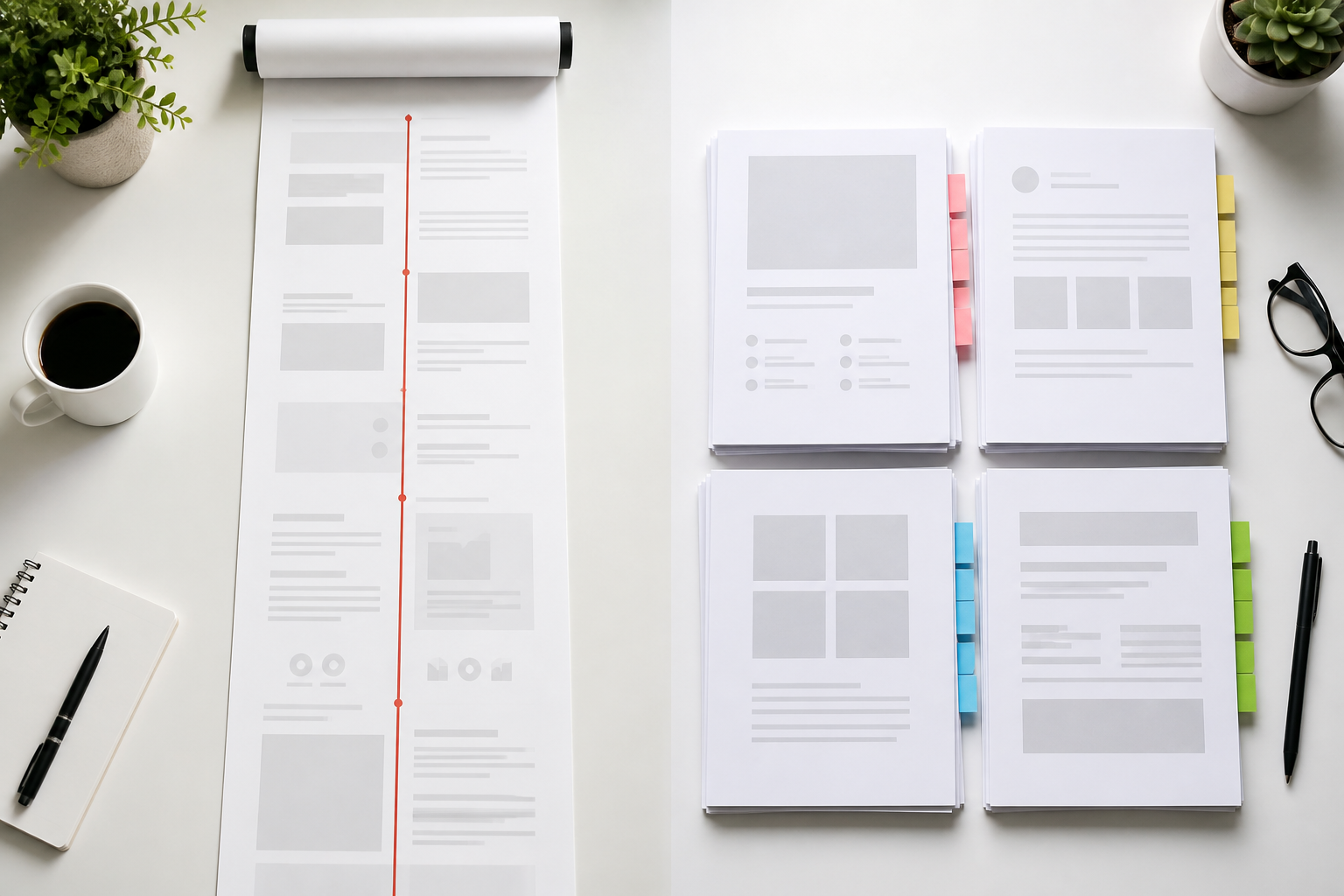
The honest answer is that the question is slightly wrong, and the wrongness is where most of the bad decisions come from.
Neither format converts better in general. What actually determines the outcome is whether your visitors arrive knowing what they want or needing to be convinced — and those two situations call for opposite structures. A one-page site is excellent for the first and quietly terrible for the second.
Here’s how to work out which situation you’re actually in, plus the SEO consequences nobody mentions until after launch.
What each format is genuinely for
A one-page site puts everything on a single scrollable page. Navigation jumps to sections rather than loading new pages. It’s the right shape when there’s one thing to say and one action to take — classic landing page territory.
A multi-page site splits content across separate URLs. More structure, more room, more entry points from search.
The important distinction isn’t size — it’s whether your content has branches. If every visitor needs roughly the same information in roughly the same order, one page works. The moment different visitors need genuinely different things, a single page has to serve all of them at once, which means serving all of them worse.
When one page converts better
There’s a single conversion goal
Campaign landing pages, event registrations, product launches, app downloads. One offer, one action, no reason to go anywhere else. Removing navigation removes exits — that’s the whole mechanism, and it works.
Your offer is simple enough to explain in one scroll
A local service business with one service. A freelancer. A single product. If the full pitch fits comfortably in a scroll, splitting it across pages adds clicks without adding clarity.
Visitors arrive already interested
Traffic from ads, social, or referral usually arrives with intent — they clicked because something already appealed. They don’t need to be led through a discovery process, they need the shortest path to acting.
The audience is mobile-heavy
Scrolling is the natural mobile behavior. Tapping through a menu is friction. A one-page site is closer to how people already use their phones.
Speed to launch matters
One page is faster to design, faster to build, faster to get live. For validating an idea or hitting a deadline, that’s a real advantage rather than a compromise.
When multi-page converts better
Different visitors need different things
The clearest signal. If a returning customer needs support, a prospect needs pricing, and a job candidate needs your careers page, one page trying to serve all three serves none of them well.
The purchase needs research
Higher-consideration purchases involve people reading, leaving, coming back, and comparing. That behavior needs pages they can return to directly — and, practically, share with the colleague who has to approve it.
You have multiple services or products
Each needs room to be explained properly, and each attracts a different search query. Compressing five services into five sections of one page means none of them gets treated seriously. For small businesses that need a few clear pages rather than a scroll manifesto, see website design for small business.
Search traffic matters to you
This is the big one, and it’s covered properly below.
You’ll be adding content over time
One-page sites don’t grow well. Every addition makes the page longer and the whole thing harder to navigate. If you plan to publish, expand, or add services, starting on one page means rebuilding later.
You need to build trust before the ask
Credibility-sensitive services — legal, medical, financial, high-value B2B — usually need room for detail, credentials, case studies, and process. That’s hard to do without looking cluttered on a single page.
The SEO reality
This is the part that gets discovered too late, and it’s the strongest structural argument against one-page sites for most businesses.
One page can rank for approximately one thing. A page has one title tag, one meta description, one primary topic. Search engines evaluate it as a unit. You can’t meaningfully optimize a single page for “web design for restaurants” and “logo design for restaurants” and “SEO for restaurants” at once — the page has to pick.
Multi-page sites multiply entry points. Each page targets its own query and can rank independently. A ten-page site has ten chances to be found; a one-page site has one.
Internal linking barely exists on a one-page site. Links between related pages are a real ranking signal and a real navigation aid. Anchor links to sections don’t do the same work.
Long pages dilute topical focus. A page covering five subjects looks less authoritative on each of them than five focused pages do.
None of this means one-page sites can’t rank. They can, and for a narrow local business targeting one main query, one well-optimized page may be entirely sufficient. But if organic search is meant to be a meaningful channel, you’re capping it deliberately — which is why SEO services and structure decisions belong in the same conversation.
The practical rule: one page is fine when search is a minor channel. It’s a poor choice when search is the plan.
Practical problems people hit
One-page sites, in practice:
- They get long. What started tidy becomes a scroll nobody finishes.
- Analytics get vague — you see one pageview, not which sections held attention. Scroll-depth tracking helps and needs setting up deliberately.
- Sharing a specific part is awkward. “It’s about two-thirds down” is not a link.
- Everything loads at once, which makes weight discipline more important than usual. (See website speed test.)
- They’re hard to extend without a rebuild.
Multi-page sites, in practice:
- More clicks between arrival and action, and every click loses someone.
- Navigation has to be genuinely good, or people get lost.
- More pages to keep current, and stale pages are worse than absent ones.
- Costs more to build and maintain.
The middle ground most businesses should consider
The choice isn’t binary, and this is where a lot of sensible sites land.
A short multi-page site. Home, services, about, contact — four or five pages. Most of the SEO benefit, most of the structure, none of the sprawl. This is the right answer for a large share of small businesses, and it gets skipped because the debate is framed as one-versus-many.
A long homepage plus a few key pages. Homepage covers the full pitch in one scroll, with separate pages for each service and a contact page. You get the one-page flow for people who just want the overview, and dedicated pages for search and for people who want depth.
One-page landing pages alongside a multi-page site. Not either/or at all — the main site is multi-page, and each campaign gets its own dedicated one-page landing page. This is what most companies running paid traffic actually do, and it’s usually the right structure: the site handles discovery, the landing pages handle campaigns. If conversion on those campaign pages is the bottleneck, a conversion rate audit helps isolate why.
The question to ask
Not “which converts better” — ask this instead:
Does every visitor need the same thing, in the same order?
If yes, one page. If different people need different things, you need pages.
Then a second check: is organic search meant to be a significant source of customers? If yes, that pushes toward multi-page regardless of the first answer.
The short version
- Neither format wins in general; the deciding factor is whether visitors need the same thing or different things
- One page suits single conversion goals, simple offers, pre-qualified traffic, and fast launches
- Multi-page suits varied audiences, research-heavy purchases, multiple services, and growing content
- One page can rank for roughly one query — a hard ceiling if search is meant to be a real channel
- One-page sites don’t extend well; adding content means rebuilding
- A short multi-page site (4–5 pages) is the underrated middle answer for most small businesses
- Running a multi-page site plus dedicated one-page landing pages for campaigns isn’t a compromise — it’s usually the correct structure
Still deciding between a landing page and a short site? Contact us with what a visitor should do — that one sentence usually settles the structure before design starts.
Plenox Studio
Practical notes from Plenox Studio on hiring decisions, scope, and builds that match how the business actually works.