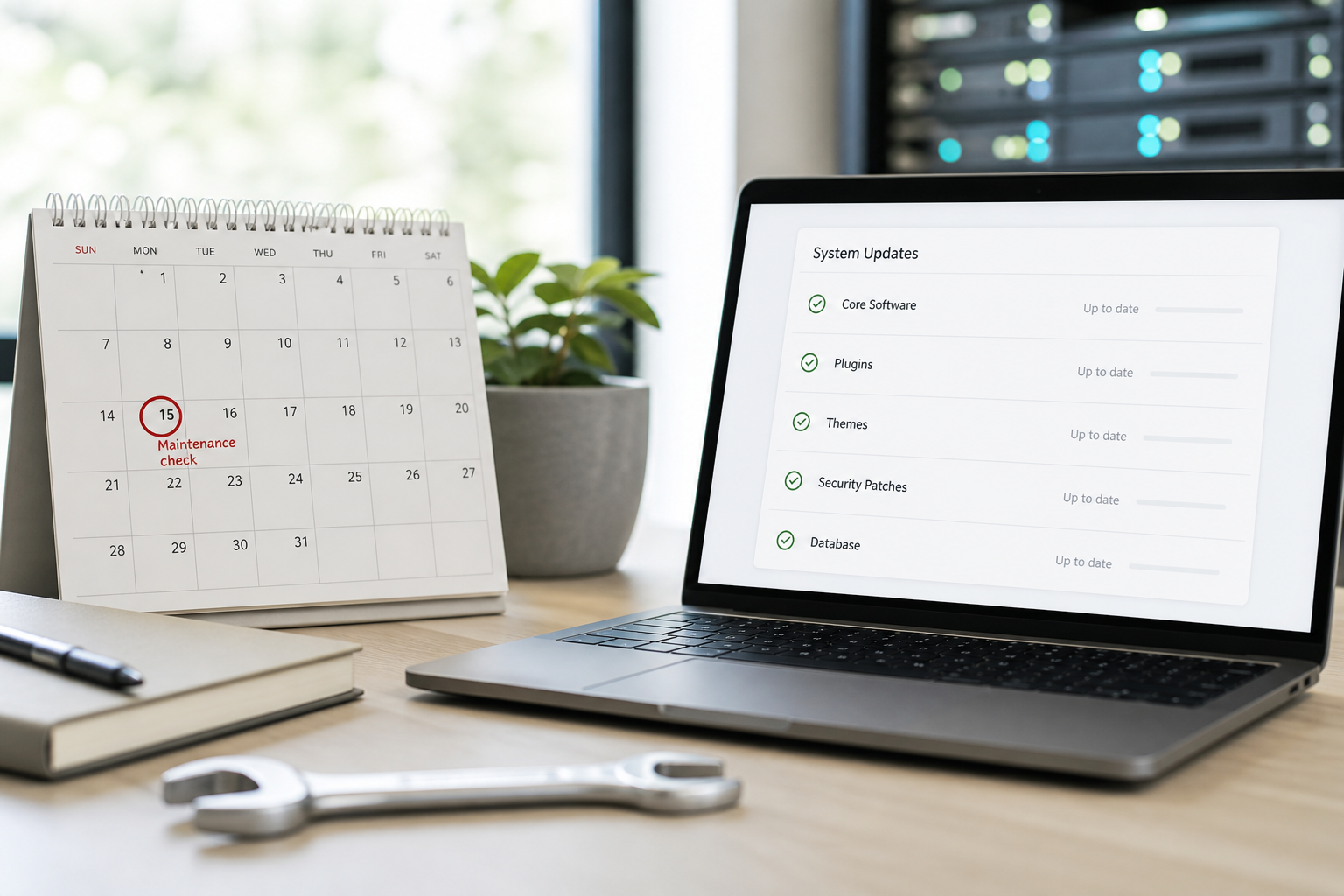
Maintenance is the cost nobody mentions while you’re buying the website. The build gets a price tag; the keeping-it-running part shows up afterwards as hosting renewals, plugin updates, security patches, and the occasional “can someone change our opening hours” invoice.[1]
It’s also the cost most often budgeted at zero, which is how sites end up two years old, running outdated software, never backed up, and broken in three places nobody noticed.
Here’s what it actually costs and what you’re paying for. For the build-side ranges this sits next to, see how much a website costs.
The short answer
Website maintenance runs $20 to $500+ per month in 2026. DIY tools $15–$50/month, freelancers $50–$150/month, professional managed plans $95–$395/month for most businesses, with ecommerce and high-traffic sites higher.[2]
The averages, which are more useful than the range:
- The average small-to-mid-size business pays around $100–$300/month for professional full-service care[2]
- Typical small business sites run $50 to $500 a month; simple sites sit near the bottom, anything with bookings or a store climbs fast[1]
- For small websites a normal budget is $25–$150/month; for business-critical sites where leads matter, $150–$600/month; ecommerce $500–$2,000+/month depending on risk[3]
Sources vary because “maintenance” covers wildly different scopes. What matters is matching the tier to what your site actually is.
What you’re actually paying for
Maintenance isn’t one thing. It’s five jobs bundled together, and pricing any offer means checking which of the five it covers.[1]
1. Hosting, domain, and email. The fixed bills. Standard domains run $10–$30/year[4]; hosting varies enormously by type, from a few dollars a month shared up to substantial figures for dedicated infrastructure.
2. Software updates. CMS core, plugins, themes, dependencies. The unglamorous work that prevents most problems. More plugins and apps mean more updates and compatibility testing.[2]
3. Security and backups. Monitoring, patching, off-site backups, and the ability to restore. Malware removal, firewalls, and advanced security add to the price.[2] What “real” backups require is covered in how to back up your website.
4. Content edits. Changing prices, hours, staff, adding a page. Included edit hours and frequent content changes raise the tier[2], and outsourced content updates can run up to around $190/month.[5]
5. Performance and monitoring. Uptime checks, speed, and fixing things before customers notice — the work behind uptime monitoring and performance optimization.
If a maintenance quote doesn’t specify how it handles all five, that’s the thing to ask about — the gap is usually content edits, which is where “cheap plan plus surprise invoices” comes from.
What moves the price
Custom features, integrations, and large sites need more work. More plugins and apps mean more compatibility testing. High-traffic sites need more monitoring, caching, and faster recovery. Priority and 24/7 emergency support cost more but reduce downtime risk.[2]
Site type is the biggest factor. A five-page portfolio site doesn’t cost the same to maintain as a 500-page ecommerce store — every additional plugin, product listing, or user account adds complexity behind the scenes.[6]
Platform matters too. WordPress sites generally need more hands-on maintenance than hosted platforms like Squarespace or Wix[7] — the trade-off for WordPress’s flexibility is that its many independently-maintained components all update on their own schedules.
Ecommerce is a different tier entirely. Ecommerce platforms commonly run $1,500–$2,500/month at the managed end[8], because a store carries live transactions, payment data, and downtime that costs money by the hour. Related: ecommerce website cost.
Your three options
DIY
~$15–$50/month.[2] Hosting plus a backup plugin plus a security plugin, and you do the updates.
Works if: the site is simple, you’re comfortable with the platform, and you’ll actually do it monthly. That last condition is where this option usually fails — DIY maintenance stops happening about three months in, and nobody notices until something breaks.
Freelancer
~$50–$150/month.[2] Someone competent handles updates and small changes.
Works if: you have a good relationship and their availability is reliable. The risk: one person, and if they’re unavailable during an incident, so is your support. Same continuity trade as in freelancer vs agency.
Agency or managed service
~$95–$395/month for most businesses, higher for complex sites.[2] Professional maintenance ranges from $100 to $2,500 per month depending on scope.[6]
Works if: the site matters commercially, or nobody internally will own it. The trade: more expensive, and you’re buying availability and continuity as much as task completion. That’s our maintenance & support lane.
Hourly, for reference: ad-hoc maintenance runs $50–$150/hour, though monthly plans are far better value.[2] Hourly is fine for occasional one-off changes and expensive as a primary arrangement, because nobody’s watching between calls.
Why skipping it costs more
The argument against maintenance is that nothing has gone wrong. The argument for it is arithmetic.
A hacked site can cost $3,000 to $25,000+ to recover — far more than years of preventive maintenance.[7]
And that’s only the direct cost. It doesn’t include lost sales during downtime, the search rankings that drop when Google flags your site with a security warning, or the customers who saw the warning and now associate your business with it. Prevention sits next to security & backups; cleanup after infection is the expensive path covered in is my website safe?.
An unmaintained site suffers security vulnerabilities, outdated content, and poor performance, which ultimately hits brand reputation and revenue.[5] The failure is rarely dramatic — it’s gradual, and by the time it’s visible, the fix costs more than the prevention would have.
A realistic budget by situation
Simple brochure site, few changes: $25–$100/month. Hosting, domain, automated backups, periodic updates.
Small business site with occasional edits: $100–$300/month. The above plus real support and a few content changes included.
Lead-generating business site: $150–$600/month.[3] Faster response, more monitoring, more included edit time — because downtime costs enquiries.
Ecommerce: $500–$2,000+/month.[3] Higher stakes, more moving parts, transaction data to protect.
Annually: most small business sites land somewhere between $1,000 and $6,000 a year all-in, once hosting, domain, plan fees, and paid tools are counted.
Questions to ask before signing a maintenance plan
- What’s included versus billed separately? Especially content edits — the most common gap.
- How many edit hours per month, and what’s the rate beyond?
- Where are backups stored, and how fast is a restore? Backups on the same server aren’t real protection.
- What’s the response time for something broken? And does that differ outside business hours?
- Is there a monthly report? Otherwise you’re paying for invisible work on faith.
- What happens if the site gets hacked? Included, or a separate emergency charge? This one catches people out.
- Can I leave? Contract length, notice period, and whether you keep access to everything.
Question six is worth pressing on. Some plans cover prevention and charge separately for cleanup — which is defensible, but you want to know before the incident rather than during it.
Where you can genuinely save
- Fewer plugins. Each one is ongoing update and compatibility work. Delete what you don’t use.
- A hosted platform instead of self-hosted, if your needs are simple — the platform absorbs the maintenance burden.
- Do content edits yourself. If your CMS is set up well, routine changes shouldn’t need a developer, and this is the most commonly billed item.
- Annual rather than monthly billing, where discounts apply.
- Bundle hosting and maintenance with one provider rather than splitting them.
Where not to save: backups and security. These are the two line items whose absence costs multiples of what they’d have cost.
The short version
- Most small businesses pay $100–$300/month for professional maintenance; simple sites $25–$100, ecommerce $500–$2,000+
- DIY $15–$50/month, freelancer $50–$150/month, managed $95–$395/month for most
- Maintenance is five jobs: hosting/domain, updates, security and backups, content edits, performance — price any offer against that list
- Content edits are the most common gap in cheap plans and the most common surprise invoice
- WordPress needs more hands-on maintenance than hosted platforms
- A hacked site costs $3,000–$25,000+ to recover, before counting lost sales and rankings
- Ask specifically whether hack cleanup is included or charged separately
- Save on plugins and doing your own edits; never save on backups and security
- Budget roughly $1,000–$6,000/year all-in for a typical small business site
Sources
- UENI — Website maintenance cost in 2026: what’s normal
- Website Maintenance Services — How much does website maintenance cost (2026)
- Middlehost — Website maintenance cost & charges: 2026 guide
- WP Creative — Website maintenance cost in 2026
- Elementor — Website maintenance cost: full pricing breakdown
- Gravitate — How much does website maintenance cost in 2026
- HowMuchDoesAWebsiteCost — Website maintenance costs 2026
- Aalpha — How much does website maintenance cost in 2026
- GoDaddy — How much does it cost to maintain a website in 2026
Figures compiled August 2026 from published 2026 pricing research. Ranges vary by region and provider — verify current pricing before budgeting.
Want maintenance that covers updates, off-site backups, monitoring, and a clear edit allowance — not a vague monthly fee? That’s our Maintenance & Support work.

Plenox Studio
Practical notes from Plenox Studio on hiring decisions, scope, and builds that match how the business actually works.